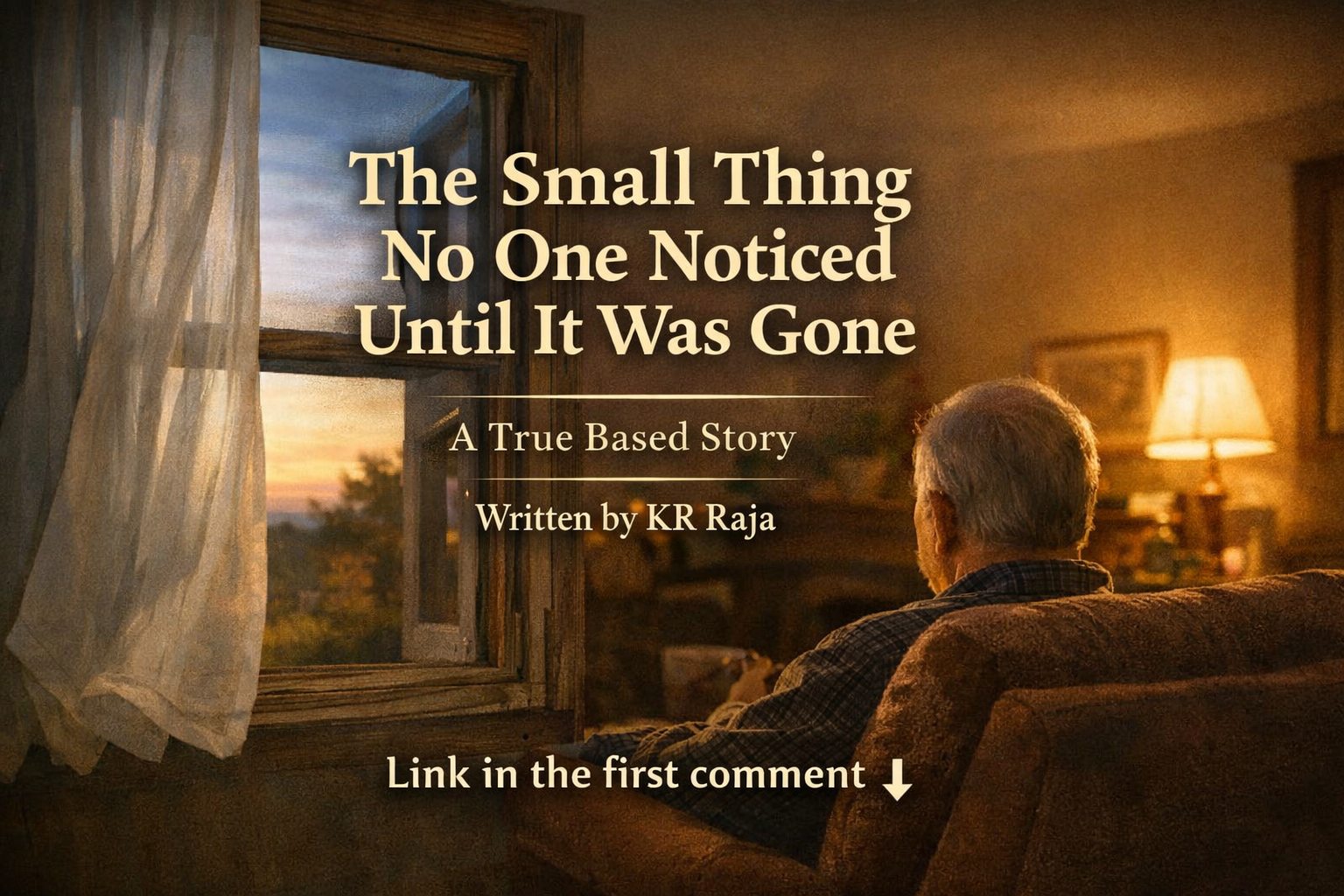
A True Based Story
No one could remember exactly when it started.
It wasn’t something you would mark on a calendar or mention in conversation. It simply became part of the background, like the hum of a refrigerator or the way the house settled at night.
Every evening, just before dusk, Martin would walk through the living room and open the windows.
All of them.
Not wide. Just enough.
The one near the sofa. The one above the sink. The narrow one in the hallway that always stuck. He moved slowly, the way people do when they are no longer in a hurry to get anywhere. He never announced it. Never sighed dramatically. Never made a point of it.
He just did it.
His wife, Ellen, usually didn’t notice. She was often in the kitchen at that hour, rinsing dishes or wiping the counter even though it was already clean. The kids had grown and moved out, but the habit stayed long after the house went quiet.
The air would change, subtly. The warmth of the day would ease out. The rooms would feel less heavy. The curtains would lift slightly, as if the house itself were breathing.
If someone asked Ellen later why the house always felt comfortable in the evenings, she wouldn’t have known what to say.
“It just does,” she would have replied.
Martin had been like that for most of their marriage. Doing things that didn’t call attention to themselves.
He replaced light bulbs before they burned out. Took the trash out early so it wouldn’t smell. Tightened loose screws on door handles. Reset clocks after power outages. Made sure the car always had enough gas.
None of it was special. None of it was worth thanking someone for, at least not in the moment.
That was just life.
He had worked for decades at the same manufacturing plant. Not a job that made people lean forward when he mentioned it. He came home on time. Ate dinner quietly. Watched the news without commenting much. Fell asleep in his chair more often than he used to.
Ellen sometimes thought she should encourage him to do more. Travel. Pick up a hobby. Be more “active.”
But he seemed content. Or at least settled.
As the years passed, the kids visited less often, as kids do. Birthdays were celebrated with phone calls instead of dinners. Holidays were smaller, quieter. Still good. Just different.
Martin kept opening the windows.
Even when his knees bothered him. Even when his hands ached in cold weather. He never complained about it. He never said it was becoming harder.
He had noticed that Ellen liked how the house felt in the evenings. He had noticed she slept better when the air moved through the bedroom. He had noticed the way she sometimes said, “It’s nice tonight,” without knowing why.
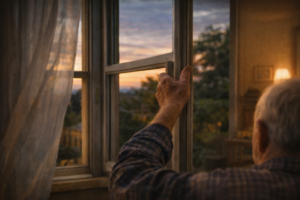
That was enough.
The year he turned seventy-two, things began to slow down in ways neither of them fully acknowledged.
Martin walked a little shorter. Took longer to stand up. Forgot small things, like where he left his glasses. Ellen teased him gently. He smiled and shrugged.
Life continued.
One evening in late autumn, the windows stayed closed.
Ellen didn’t notice at first. She was reading in the living room, the lamp casting a soft circle of light. The house felt warmer than usual, but she assumed it was the weather.
The next night, the windows stayed closed again.
And the next.
After a week, Ellen found herself opening one without thinking. Just the one near the sofa. The air felt stale, thicker somehow. She frowned, confused by her own irritation.
“Must be my imagination,” she said aloud to no one.
Martin was sitting at the table, hands folded, staring at nothing in particular.
“Are you cold?” she asked.
“No,” he said. “Just tired.”
The windows remained closed.
It wasn’t a dramatic change. Nothing stopped abruptly. The house didn’t fall apart. Meals were still eaten. Laundry still got done. Days passed.
But slowly, the evenings felt heavier.
The kitchen smelled longer after cooking. The bedroom felt stuffy at night. Ellen began waking up with headaches she couldn’t explain. She bought a fan, then another. Neither quite fixed it.
She mentioned it to Martin once.
“The air feels different,” she said.
He nodded, as if he knew exactly what she meant.
“I know,” he said quietly.
A month later, Martin stopped getting up from his chair as often. Then one morning, he didn’t get up at all.
It wasn’t sudden. It wasn’t dramatic. The doctor used calm words. Age-related. Manageable. Adjustments needed.
Martin moved more slowly now. Some days, he didn’t move much at all.
The windows stayed closed.
Ellen began to open them herself, but it wasn’t the same. She forgot some. Opened them too wide or not enough. Sometimes she didn’t bother.
One evening, standing in the hallway, she realized she couldn’t remember which ones he used to open first.
The thought unsettled her more than it should have.
Weeks passed. Then months.
Martin was still there, still breathing, still part of the house. But something had shifted. A quiet rhythm was gone, and Ellen couldn’t quite name it.
One afternoon, while cleaning out a drawer, she found an old notebook. It wasn’t a diary. Just scraps. Measurements. Reminders.
“Windows before dark,” one page read, written years ago in his careful handwriting.
She sat down hard in the chair, the notebook open on her lap.
That was when it finally landed.
The windows weren’t the thing.
They had never been the thing.
They were the way he paid attention. The way he noticed how the house felt. How she slept. How the air changed when the day let go of its heat.
All those years, he had been quietly tending to the space between things. The comfort no one thinks to name.
Ellen felt a wave of grief, not sharp or overwhelming, but deep and steady. The kind that doesn’t knock you over, just settles into your bones.
She hadn’t thanked him.
Not because she was ungrateful. Because she hadn’t known there was something to thank him for.
That night, she opened the windows carefully. All of them. In the same order she suddenly remembered. The house breathed again, unevenly, imperfectly.
Martin watched from his chair.
“Feels better,” he said.
“Yes,” she replied. “It does.”
They sat there as the light faded, the air moving gently through the rooms. Nothing was fixed. Nothing needed to be said.
Some things, once seen, don’t need explaining.
The windows still open now, most evenings. Ellen does it herself. Sometimes she forgets one. Sometimes she opens them too late.
But when the air shifts and the house softens, she feels him there. Not as a memory. As a presence that shaped the ordinary days more than either of them ever realized.
And she understands, finally, how much of love lives in the small things we never think to notice until they stop.
Written by KR Raja
What small, everyday thing did someone do in your life that you only truly understood after it was no longer there?